
Why SEO Is the Best Growth Channel for Peptide Brands


.jpg)
Table of Contents
Key takeaways
- Paid ads aren’t a stable foundation for peptide brands. Campaigns can be restricted, flagged, or shut down at any time, making revenue unpredictable.
- SEO builds an asset that keeps working over time. Content, rankings, and authority compound, creating a steady flow of qualified traffic without ongoing ad spend.
- Organic search gives you control over your growth channel. You’re not dependent on third-party platforms that can change policies or suspend accounts without warning.
- Publishing content alone isn’t enough to drive results. Technical SEO, keyword targeting, and authority building all work together to create consistent performance.
- Brands that invest early create a lasting advantage. As authority grows, it becomes easier to rank, attract leads, and scale revenue in a way competitors can’t easily replicate.
If you're running a peptide brand, you already know the advertising problem. You've probably seen it firsthand—a campaign disapproved, an ad account flagged, or a policy change that wiped out a profitable channel overnight.
For peptide ecommerce brands, paid advertising is difficult to rely on as a primary growth strategy. It often comes with more risk than consistency.
That's what makes search engine optimization (SEO) the most reliable peptide brand growth channel available in 2026. Not because it's trendy but because it's often the only scalable, sustainable option for peptide businesses operating inside tight industry regulations.
Why peptide ads are so difficult to run
Peptides often fall into restricted healthcare and pharmaceutical categories across major ad platforms. While policies aren’t always clearly defined, enforcement is consistent and tightening.
Here’s how those limitations typically show up in practice:
Ad platform restrictions and enforcement
Google Ads bans or severely restricts campaigns for unapproved pharmaceuticals and many supplement categories, especially compounds like semaglutide, tirzepatide, or peptides marketed around weight management, longevity, or performance-related claims.
Meta's advertising policies are similarly strict, often flagging peptide products for potential health claim violations before an ad ever goes live.
These enforcement patterns align with broader regulatory expectations, including guidance from the Federal Trade Commission on how health-related products can be marketed.
Higher scrutiny across your entire web presence (YMYL)
Peptide brands fall under Google's "Your Money or Your Life" (YMYL) classification, content that could significantly impact a user's health or finances. While ad platforms enforce their own restrictions, Google also applies stricter quality standards to how your site is evaluated in search.
That means your content is held to a higher bar for accuracy, credibility, and trust. Compliant, authoritative SEO isn’t optional. It’s the baseline for visibility in this space.
The real cost of relying on paid ads (even when they work)
Even for peptide brands that manage to run ads without getting flagged, the economics can be unpredictable. You’re investing in a channel you don’t control, where performance and access can change quickly due to policy enforcement or account reviews.
You're renting traffic, not building an asset
Every dollar you put into paid ads buys traffic for that moment. When the budget stops or campaigns are paused, that traffic drops off. There’s little residual value and limited long-term return beyond the campaign itself.
SEO works the opposite way. Content you publish today can continue generating organic traffic and revenue for years. Rankings build, authority grows, and your content library turns into a long-term traffic and revenue asset that isn’t tied to daily spend.
Rising CPCs limit long-term return
In the supplement and wellness categories where peptide brands can still advertise, cost-per-click (CPC) tends to increase as more brands compete for a limited pool of compliant inventory.
This leads to higher spend just to maintain the same level of traffic, with little long-term value being built in the background. Much of that investment is tied to active campaigns, so results taper off quickly when you pause.
Account bans are a business risk, not just an inconvenience
We've spoken with peptide brand founders who were spending tens of thousands per month on paid ads when their accounts were suspended without warning. Revenue dropped to near-zero overnight. No appeal timeline, no backup plan.
That's not just a marketing problem. It's a business continuity risk. Brands that have built organic traffic aren't exposed to the same level of disruption because their primary growth channel isn't controlled by a third-party platform.

How SEO drives growth for peptide ecommerce brands
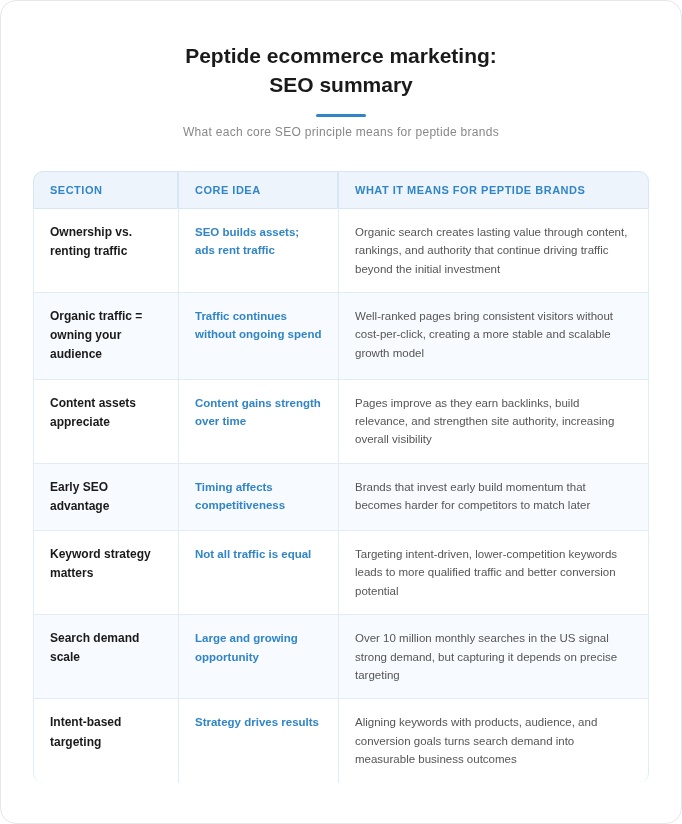
The fundamental difference between paid ads and SEO is ownership. With organic search, you're not renting traffic. You're building an asset in the form of indexed content, search rankings, and domain authority that continue driving traffic well beyond the initial investment.
Organic traffic = owning your audience
A well-ranked page can attract qualified leads every day, whether you're actively investing in it or not. A blog post that ranks for peptide keywords like "anti-aging peptides" or "BPC-157 benefits" can continue bringing in visitors month after month, with no cost-per-click. That's a fundamentally different business model for growing a peptide brand.
Instead of paying for each visitor individually, you invest in content and infrastructure, then continue capturing value from that work. Your organic traffic becomes a compounding revenue stream instead of a line item that resets with each billing cycle.
Content assets appreciate, not depreciate
Unlike ad spend, which typically delivers value only while campaigns are active, SEO content assets can gain value over time. A collection page optimized for terms like “weight management peptides” or “peptides for performance” grows stronger as it earns backlinks, builds click-through history, and develops topical relevance in search results.
Peptide brands that invest in SEO early can build a compounding advantage that becomes harder for late movers to close, especially in competitive markets where average order values tend to be higher and reaching qualified audiences through compliant channels is more constrained.
Keyword research: The foundation of peptide marketing strategy
Effective keyword research is the backbone of every successful peptide marketing strategy. The right peptide keywords—those with real commercial intent and achievable competition—are what drive qualified traffic.
The peptide search landscape drives over 10 million monthly searches in the US alone. Understanding which of those queries align with your peptide products, your target audience, and your conversion goals is what turns search demand into actual results.
Generic keyword research isn’t enough. Without intent-driven targeting, even high search volume won’t translate into meaningful results.
Rankings compound: The topical authority flywheel
A flywheel, in this context, is a self-reinforcing cycle where each gain makes the next one easier to achieve. As you publish more optimized content, your site builds topical authority. That authority makes it easier to rank new pages, which attracts more backlinks and strengthens domain authority. As rankings improve across more pages, search visibility expands, bringing in more organic traffic and qualified leads.
This compounding effect creates a structural advantage for peptide brands that invest early.
Peptide ecommerce marketing: SEO summary
Proof: How one peptide brand grew revenue with SEO alone
InfiniWell is a peptide supplement brand that faced the exact constraints described above: ad restrictions, limited paid channels, and an organic presence that wasn't generating revenue.
Lantern Sol built out their SEO foundation: technical infrastructure, keyword-targeted content clusters, and niche-relevant link building focused on building real authority in the peptide industry.
In six months: 1,343 keyword rankings, 20 new top-3 positions, +672 monthly organic visitors, and +$367,000 in revenue directly attributed to organic search. Average order value climbed, and qualified leads increased. None of it depended on ad accounts, bidding strategies, or advertising policy compliance.
That’s the SEO compounding flywheel in action for a peptide brand. And critically, those results don’t disappear overnight due to a platform policy change, even if algorithm updates cause fluctuations.
Read the InfiniWell case study.
For the full breakdown of how SEO works specifically for peptide ecommerce—keyword research strategy, technical foundations, and GEO/AI search optimization—read our complete peptide SEO guide.
SEO, peptide brand growth channel: FAQs
Is SEO worth it for peptide brands?
Yes. SEO is both a growth and risk strategy. It builds owned traffic that isn’t tied to ad platforms, making it a core part of sustainable digital marketing for peptide brands.
Can you run Google Ads for peptides?
Not reliably. Peptide ads face strict restrictions, so most brands rely on organic search and content-driven digital marketing to scale.
How do you market peptides online without ads?
Focus on SEO, content, email, and social. Strong keyword targeting and educational content help generate leads through organic traffic while staying compliant.
How much should a peptide brand invest in SEO?
It depends on competition and growth goals. Consistency matters more than short-term spend.
How long before SEO drives revenue for peptides?
Typically 3–6 months for traction, with growth building from there.
Up Next
Interested in detailed step-by-step methods to grow your account?


