Headless vs Shopify Themes: Which One Is Actually Better for Your Store?

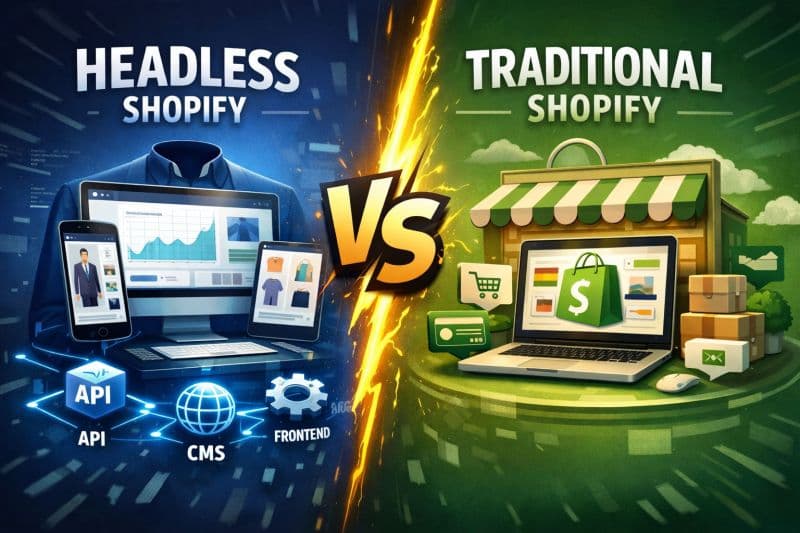
The decision between headless commerce and Shopify themes is not just a technical decision. It is a strategic one. It affects cost structure, operational complexity, conversion rate, and long-term scalability. Both approaches can support strong ecommerce performance. Both can rank well in search. Both can scale. The difference lies in how they are implemented and what your store actually needs. Shopify themes rely on Liquid templates and server-side rendering to deliver structured, predictable storefronts. Headless Shopify architecture setups separate the front end from the backend, allowing greater control over UX and interaction-driven rendering. The assumption that headless is automatically faster or better for Shopify SEO is often oversimplified. In practice, architecture, implementation quality, and growth stage matter more than labels. This guide is written for founders, ecommerce leaders, and growth teams that are evaluating whether their current Shopify architecture is limiting performance.
Key takeaways
- Shopify themes are faster to launch and more cost-effective for most stores.
- Headless setups offer greater control over UX and front-end performance.
- Shopify SEO can perform well on both setups when implemented correctly.
- Headless does not automatically improve rankings.
- The right choice depends on growth stage, complexity, and performance goals.
What Are Shopify Themes?
Shopify themes are the native storefront framework built directly into Shopify. They use Liquid, Shopify’s templating language, templates to render pages and control layout, structure, and dynamic content.
With Shopify themes:
- The front end and back end are tightly connected.
- Liquid templates generate HTML on the server.
- Apps and scripts extend functionality inside the Shopify theme development environment.
This model relies on server-side rendering, meaning Shopify processes the page before it reaches the browser.
For many ecommerce brands, this structure provides:
- Faster implementation
- Lower development cost
- Built-in compatibility with Shopify apps
- Predictable Shopify SEO behavior
Themes are template-driven. The architecture is structured around predefined layouts and sections that control how content appears.
What Is Headless Commerce on Shopify?
Headless commerce separates the front end from Shopify’s core backend. Instead of Liquid templates controlling rendering, the storefront pulls data through APIs and displays it using frameworks like React. The front end becomes a custom application that communicates with Shopify for products, carts, and checkout.
In a headless setup:
- Shopify acts as the commerce engine.
- The front end controls design, routing, and interactions.
- Rendering can happen client-side or through advanced server-side rendering setups.
This approach is interaction-driven. It prioritizes dynamic UI updates and custom user experiences.
How Rendering Impacts Ecommerce Performance
Rendering strategy directly affects ecommerce performance.
Shopify Themes
Shopify themes rely on server-side rendering through Liquid templates. Shopify builds the HTML and sends it to the browser. After that, scripts and apps enhance the page. This structure is stable and SEO-friendly. Search engines receive fully rendered HTML immediately.
However:
- Heavy apps can increase script execution time.
- DOM updates may slow interactions on complex stores.
- Custom UX patterns can be limited by theme architecture.
Headless Commerce
Headless storefronts often use modern frameworks that optimize how UI updates occur. Instead of refreshing large portions of the page, they update only the necessary components.
This can improve:
- Interaction speed
- Animation smoothness
- Perceived performance
However, SEO performance depends on implementation. Poorly configured client-side rendering can create indexing challenges if search engines do not receive structured HTML. Well-implemented server-side rendering or hybrid rendering in headless builds can resolve this. The performance advantage is not automatic. It depends on engineering quality.
Does Shopify SEO Headless Rank Better?
There is a common assumption that headless automatically improves Shopify SEO. That assumption is incorrect.
With Shopify Themes
Shopify themes:
- Deliver server-rendered HTML by default
- Provide predictable URL structures
- Handle canonical tags consistently
- Integrate directly with Shopify’s SEO settings
For most brands, this creates a stable SEO foundation.
With Headless
From an SEO perspective, both setups can perform equally well. The deciding factor is execution. In many ecommerce audits, structural issues matter more than whether a store is theme-based or headless.
In ecommerce SEO audits, structural issues such as crawl depth, internal linking, content gaps, and technical misconfigurations typically matter more than whether a store is headless or theme-based.
If you want a broader understanding of how Shopify SEO functions across architectures.
Headless is not an SEO upgrade. It is an architectural choice.
ProsCons
Custom metadata handling
Misconfigured rendering can block crawling
Advanced schema implementation
Incorrect canonical logic can create duplication
Performance tuning flexibility
Overcomplicated architecture can slow deployment
Fine-grained routing logic
Higher technical oversight required
Cost and Maintenance Considerations
Architecture decisions affect long-term cost.
Theme-based stores are typically easier for internal teams to manage.
Headless offers flexibility, but flexibility requires resources. For growing brands without a dedicated engineering team, complexity can slow iteration.
For brands without dedicated engineering support, this complexity can slow iteration rather than accelerate it.
Shopify ThemesHeadless Commerce
Pros
• Lower upfront development cost • Faster time to market • Easier app integration • Smaller maintenance overhead • Easier for internal teams to manage
• Greater flexibility and customization • Full control over front-end architecture • Advanced performance optimization potential • Scalable for complex UX requirements
Cons
• Limited front-end flexibility • Constrained by theme architecture • Performance tied to Liquid-based rendering
• Higher development investment • Ongoing engineering requirements • More complex deployment workflows • Increased QA and testing needs
Scalability and Customization
Scalability is often the strongest argument for headless commerce. That is accurate in certain scenarios.
Headless allows:
- Full control over UX
- Advanced personalization
- Custom checkout flows
- Integration with multiple front ends
This matters for brands with:
- International storefronts
- Large product catalogs
- Advanced merchandising logic
- Performance-sensitive experiences
Shopify themes can scale effectively for many mid-sized brands. However, extreme customization often requires working around theme limitations. The question is not whether headless is more scalable. It is whether your store needs that level of scalability today.
The key question is not whether headless scales further.
It is whether your business needs that additional flexibility now.
When Shopify Themes Make More Sense
Shopify themes are often the better choice when:
- You need to launch quickly
- SEO stability is a priority
- Budget is constrained
- Custom UX is not a differentiator
- Your product catalog is manageable
Many seven-figure ecommerce brands operate successfully on optimized Shopify themes.
Performance improvements can often be achieved by:
- Reducing app bloat
- Optimizing scripts
- Improving internal linking
- Streamlining template structure
Architecture changes are not always required to fix performance. Without clear objectives, headless increases complexity without guaranteeing growth.
When Headless Is the Better Fit
Headless becomes compelling when:
- UX is a core competitive advantage
- Complex product logic demands custom rendering
- You require advanced personalization
- Your team includes experienced developers
- Performance tuning is strategic, not reactive
In these cases, the flexibility of headless can support long-term growth. However, migration should follow a clear business case. Moving to headless without defined goals often creates technical debt rather than performance gains. Implementation quality determines results.
The Strategic Decision Framework
Instead of asking which is better, consider:
- What is limiting growth today?
- Are performance issues architectural or implementation-based?
- Does your team have the resources to maintain custom infrastructure?
- Will UX improvements materially impact conversion rate?
Shopify themes are structured and predictable.Headless is flexible and customizable. Both can support strong ecommerce performance. The difference lies in how they are implemented and maintained.
Ready to Make the Right Architecture Decision?
Choosing between Shopify Themes and headless commerce should not rely on assumptions. It should be based on how your current architecture impacts Shopify SEO and the decision of custom Shopify development, ecommerce performance, and long-term scalability.
At Lantern Sol, we specialize in ecommerce-focused technical strategy. We evaluate:
- Rendering structure and server-side output
- Liquid template efficiency
- SEO implementation and crawl behavior
- App-related performance bottlenecks
- Architectural limitations slowing growth
If you want clarity on what is actually holding your store back, and whether a theme optimization or architectural shift makes sense, request a structured ecommerce SEO audit. We will identify what needs improvement, what does not, and what will generate measurable impact.
Final Thoughts
Headless is not automatically better. Shopify themes are not outdated. For many brands, optimizing a well-built theme delivers meaningful gains without adding complexity. For others, headless unlocks control that themes cannot provide.
The right choice depends on your growth stage, technical resources, and strategic priorities. If you are evaluating architecture decisions and want clarity on how your current setup impacts Shopify SEO and ecommerce performance, a structured audit is the best starting point.
The right decision depends on your stage, resources, and measurable objectives.
If you are evaluating whether architecture is limiting performance, a structured ecommerce SEO audit provides clarity on what needs to change and what does not.
Frequently Asked Questions about Headless vs Shopify Themes
How do free themes compare to paid options for online stores?
Free themes are suitable for smaller stores with standard needs. They offer solid structure, built-in Shopify SEO compatibility, and quick setup. Paid themes typically include more advanced layout options, performance optimizations, and merchandising features. The difference is usually flexibility and depth, not basic functionality.
What are the essential features to look for in an e-commerce platform theme?
Look for clean code structure, fast load performance, mobile responsiveness, flexible product page layouts, strong filtering options, and compatibility with key apps. Clear metadata controls and structured data support are also important for long-term SEO stability.
How to customize a theme without coding knowledge?
Use Shopify’s theme editor to adjust sections, typography, colors, and homepage blocks. Many modern Shopify themes include drag-and-drop functionality. Apps can extend features without modifying Liquid templates directly.
How to choose a mobile-friendly Shopify theme?
Review the theme demo on multiple devices. Test navigation, filtering, product galleries, and checkout flow on mobile. Prioritize themes with lightweight design, minimal script dependency, and responsive layouts that adapt cleanly across screen sizes.
Not sure if your Shopify architecture is holding you back?
We audit ecommerce stores to identify what's actually limiting SEO, performance, and growth — and what to do about it.
Explore web development services