
The Peptide SEO Playbook: Keywords, Content, and Link Building


Table of Contents
Key takeaways
- Peptide SEO works as a system, not a set of isolated tactics. Keyword strategy, content, links, and technical SEO build on each other, and gaps in any one layer limit what the others can achieve.
- Keyword targeting should map to the full buyer journey, from early research to purchase-ready queries. Long-tail, low-competition keywords carry the lowest difficulty, making them the fastest path to early ranking wins for newer sites.
- In a YMYL niche, educational content is your E-E-A-T engine. It's how Google decides whether to trust and rank you. Content clusters tied to product and collection pages build topical authority over time, and in a regulated space, that authority supports consistent rankings.
- Link building in a YMYL category is a trust signal before it's a ranking factor. Google needs to see endorsements from credible, relevant sites before it will rank you in a sensitive niche.
- Technical SEO determines whether everything else compounds. If the foundation is broken, content and link building won’t gain traction. Slow pages, weak mobile experience, and missing schema are common blockers. Schema is one of the fastest wins most peptide brands overlook.
Most peptide brands approach peptide supplement SEO one tactic at a time—a blog post here, a few updated product descriptions there—and wonder why nothing moves. The reality is that ranking peptide products on Google requires a system, not a series of isolated actions.
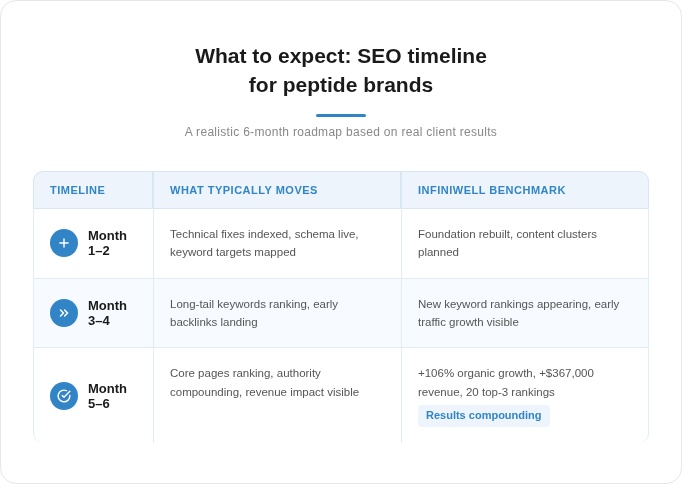
This is the peptide SEO playbook we run at Lantern Sol: five sequential steps that build on each other, validated against the actual search landscape for peptide brands in 2026. We’ve used this framework to take InfiniWell from a standing start to +106% organic growth and +$367,000 in revenue in six months.
Here’s how it works.
Step 1: Peptide keyword research
Keyword mapping for a peptide brand is more layered than most ecommerce categories. Three factors drive that complexity:
- Health claim restrictions
- Scientific names buyers use to search (compound names instead of product names)
- An unusually long research journey between first awareness and purchase
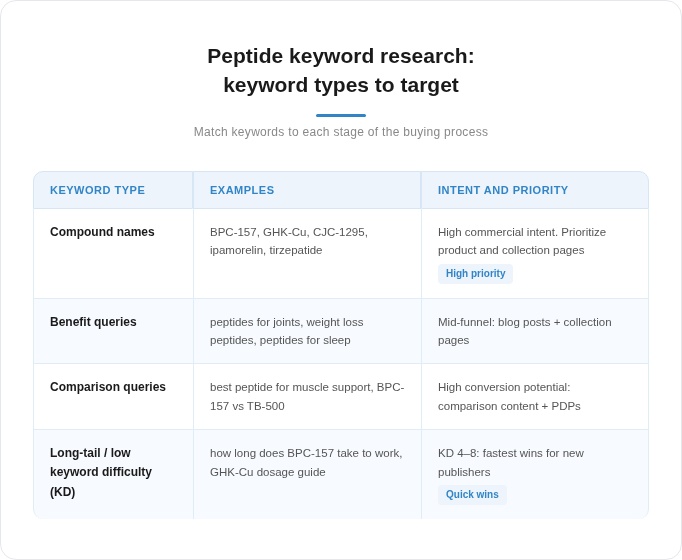
You're not just mapping terms to pages. You're matching keywords to each stage of the buying process.
Where the real opportunity lives
Not all peptide keywords are created equal. Here's how the landscape breaks down by category and where brands without established authority should focus first:
- Cognitive peptides are the most accessible entry point. Core terms like "semax" (KD 12, 9.1K/mo) and "selank" (KD 20, 4K/mo) sit well below the competitive threshold for established publishers.
- Musculoskeletal and physical performance peptides are a mixed picture. Long-tail terms are low competition, but the primary targets, "BPC-157" (KD 60–69) and "TB-500" (KD 31–50), require meaningful domain authority to crack.
- GHK-Cu is the highest-ROI play for brands that aren't yet established publishers. The cluster pulls 36K+ monthly searches across its core terms at KD 11–14 and is still largely underserved by authoritative content.
- Weight loss peptides (tirzepatide, semaglutide, Wegovy) dominate on volume—1.94M combined monthly searches in the US—but carry KD 69–89 and are effectively off-limits for newer publishers.
For research peptide brands, GLP-1 traffic doesn't convert. Those searchers want prescriptions, not research compounds. The real addressable market is the 160K–200K monthly searches across musculoskeletal support, cognitive, and skin-focused clusters. They're lower-volume but far more aligned with purchase intent and achievable to rank for.
Data sourced from Ahrefs, April 2026.
Here's how to assign each keyword type across your site:
- Map compound-name keywords to dedicated product and collection pages.
- Map benefit queries to blog content that funnels to those product pages.
- Map comparison queries to comparison content or long-form product descriptions.
- Target long-tail, low-KD terms first. These build authority faster for newer sites.
Step 2: On-page optimization
Once you have your keyword map, every page needs to be built or rebuilt around it. On-page SEO for peptide supplement brands (what we call peptide ecommerce optimization at the page level) operates at three levels:
Product pages
A peptide product page should function as a mini educational resource, not just a listing. Include the peptide name in the title and H1, a substantive description covering mechanism and use cases, FAQ content embedded on the page, product schema markup, and internal links to relevant blog content.
Generic copy across product pages is the fastest way to be filtered out of rankings. Every product, whether BPC-157, GHK-Cu, or CJC-1295, needs unique, specific, and substantial content.
Collection pages
Collection pages should target category-level keywords (“weight loss peptides,” “peptides for muscle support”) with a substantive intro paragraph, internal links to best-sellers, and clear navigation to product pages. These are your mid-funnel money pages.
Homepage
Your homepage should establish brand authority and E-E-A-T, not just announce products. Include trust signals (awards, press, certifications), a brief brand story, and internal links to your key collections and content clusters.
Step 3: Content strategy: Education over selling
In a YMYL niche like peptides, educational content is your E-E-A-T engine. A strong peptide content strategy is built around depth instead of volume. Fewer, better-researched pieces beat a high-frequency content factory in a regulated space.
The brands that rank are the ones Google considers authoritative, and authority is earned through content depth.
Blog topics that build topical authority
Build content clusters around each major peptide category you sell. For each cluster, you need:
- A collection or category page targeting the main category keyword
- 3–5 supporting blog posts answering the top questions buyers search before purchase
- Internal links connecting the blog posts back to the collection page
Example cluster for a performance peptide brand:
- Collection: “Peptides for Performance” (/collections/performance-peptides)
- Blog 1: “What Is BPC-157 and How Does It Work?”
- Blog 2: “BPC-157 vs TB-500: Which Is Better for Injury Physical Performance?”
- Blog 3: “How Long Does BPC-157 Take to Work? What the Research Shows”
- Blog 4: “Best Peptides for Muscle Support in 2026”
⚠️ Writer's Note on FDA Compliance
Avoid language that implies therapeutic outcomes, enhancement, or physiological change.
- Do not use: Heal, repair, recover, boost, improve, fix, regenerate, or any claim that the product treats or prevents a condition
- Safe modifiers: Support, promote, explore, research-backed, studied for
When in doubt, keep the copy descriptive of the compound rather than its effects. Run any claim language past compliance before publishing.
FAQ pages for AI Overview capture
Structuring content in a clear question-and-answer format is how you get cited in Google AI Overviews, ChatGPT answers, and Perplexity responses. This is what’s now called generative engine optimization (GEO).
Every blog post and collection page should include an FAQ section with 3–5 targeted questions. Implement FAQ schema on publish to maximize featured snippet and AI Overview eligibility.
Content that builds E-E-A-T without making health claims
The compliance line for peptide content sits between two failure modes:
- Generic copy that says nothing useful
- Health claims that cross into FDA-regulated territory
The approach that works (and that Google rewards) is content that educates on the research without overstating what it shows. Reference published studies, explain mechanisms, and frame findings in evidence-based language that accurately reflects what the science does and doesn't support.
Done consistently, this builds the kind of topical authority that earns trust with both search engines and readers.
Step 4: Link building for high-risk niches
For peptide brands, peptide link building isn't just a ranking tactic. It's a trust signal Google needs to see before it will rank you in a YMYL category. You need backlinks from sites that are already trusted in adjacent health and wellness spaces.
In this niche, link quality and topical relevance carry far more weight than volume.
Where to get links for peptide brands
- Wellness and longevity publications (organic, high-authority editorial coverage)
- Supplement industry sites and directories (niche-relevant, topically aligned)
- Biohacking and health optimization communities (authentic audience overlap)
- Research-adjacent sites that cover peptide science in an educational context
- Guest posts on health and fitness publications (where editorial standards are met)
Anchor text strategy
For peptide brands, anchor text must be varied and natural, never over-optimized. In a YMYL niche, an aggressive exact-match anchor text profile looks manipulative and can trigger algorithmic suppression.
Mix branded anchors, partial-match anchors, and natural contextual phrases. Prioritize anchors pointing to collection pages and product pages over the homepage.
What to avoid
- Spammy directories and low-quality general submission sites
- Private blog networks (PBNs)
- Links from irrelevant niches with no topical connection to health or wellness
- Paid link schemes without editorial cover (violates Google’s link spam policies)
Step 5: Technical SEO and schema
Without a solid technical foundation, content and link building won’t gain traction. Peptide ecommerce optimization starts here, and most brands leave this layer until last, which is a mistake.
In a competitive, regulated niche, the sites with the fastest load times, cleanest crawl paths, and most complete structured data win disproportionately.
Schema markup: The 3 you must have
- Product schema: Enables rich results for product pages (price, availability, and reviews directly in search results)
- FAQ schema: Qualifies your FAQ content for featured snippets and Google AI Overviews
- Article schema: Signals content type and topical authority for blog posts (increases eligibility for Top Stories and AI citations)
Core Web Vitals and site speed
Google uses Core Web Vitals as a ranking signal. For peptide ecommerce sites on Shopify or WooCommerce, the main culprits are unoptimized images, third-party script bloat, and render-blocking resources.
A slow site loses rankings before the content is ever evaluated.
Mobile-first indexing
Google indexes the mobile version of your site. If your mobile experience is broken (think slow load times, unreadable text, and broken navigation), your rankings suffer across all devices. Run a mobile usability audit before investing heavily in content.
GEO optimization: Structuring content for AI retrieval
Generative engine optimization is the emerging practice of structuring content so it gets cited in AI search responses.
For peptide brands, this means:
- Clear definitions at the top of every content piece
- Data-backed claims with cited sources
- FAQ format throughout
- Concise, quotable summaries that AI models can extract and surface directly
Brands that optimize for GEO now are building a compounding advantage as AI search expands. Very few peptide brands are executing this well today, which means the window for early advantage is still open.
What results to expect from this playbook
The results you see depend on your site's starting authority, how consistently you publish content, and your link-building investment. Here’s a realistic benchmark based on InfiniWell’s experience with this exact playbook:
Read the InfiniWell case study here.
For the strategic context behind this playbook—the full peptide search landscape, YMYL compliance, and GEO strategy—read our complete peptide SEO guide.
Peptide SEO strategy: FAQs
What are the best keywords for a peptide brand?
The highest-value keywords combine compound names (BPC-157, GHK-Cu, CJC-1295) with commercial intent. For newer sites, start with long-tail, low-KD terms in the cognitive and skin-focused categories. Semax, selank, and GHK-Cu cluster terms are all sub-KD 20 and still underserved by authoritative content.
As domain authority builds, layer in the primary musculoskeletal targets (BPC-157 at KD 60–69, TB-500 at KD 31–50), which carry the highest volume in the research peptide space but require an established backlink profile to compete.
How do you build backlinks for a peptide website?
Prioritize outreach to wellness publications, supplement industry sites, and longevity and biohacking communities. Guest posts with genuine editorial value perform well. Avoid PBNs, spammy directories, or irrelevant-niche links. In a YMYL category, link quality matters more than link quantity.
How much does peptide SEO cost?
Costs vary based on scope, existing site authority, and the competitive landscape. What makes SEO particularly important in this category is that paid advertising is heavily restricted for peptide brands. Meta and Google both limit this space, making organic search often the only scalable acquisition channel available.
A well-executed SEO strategy typically takes 6–12 months to produce meaningful ranking movement, but the compounding nature of organic traffic makes it the most defensible long-term investment a peptide brand can make.
Up Next
Interested in detailed step-by-step methods to grow your account?


