Best SEO Tools in 2026: 12 Tools Our Agency Uses Every Day
Key takeaways
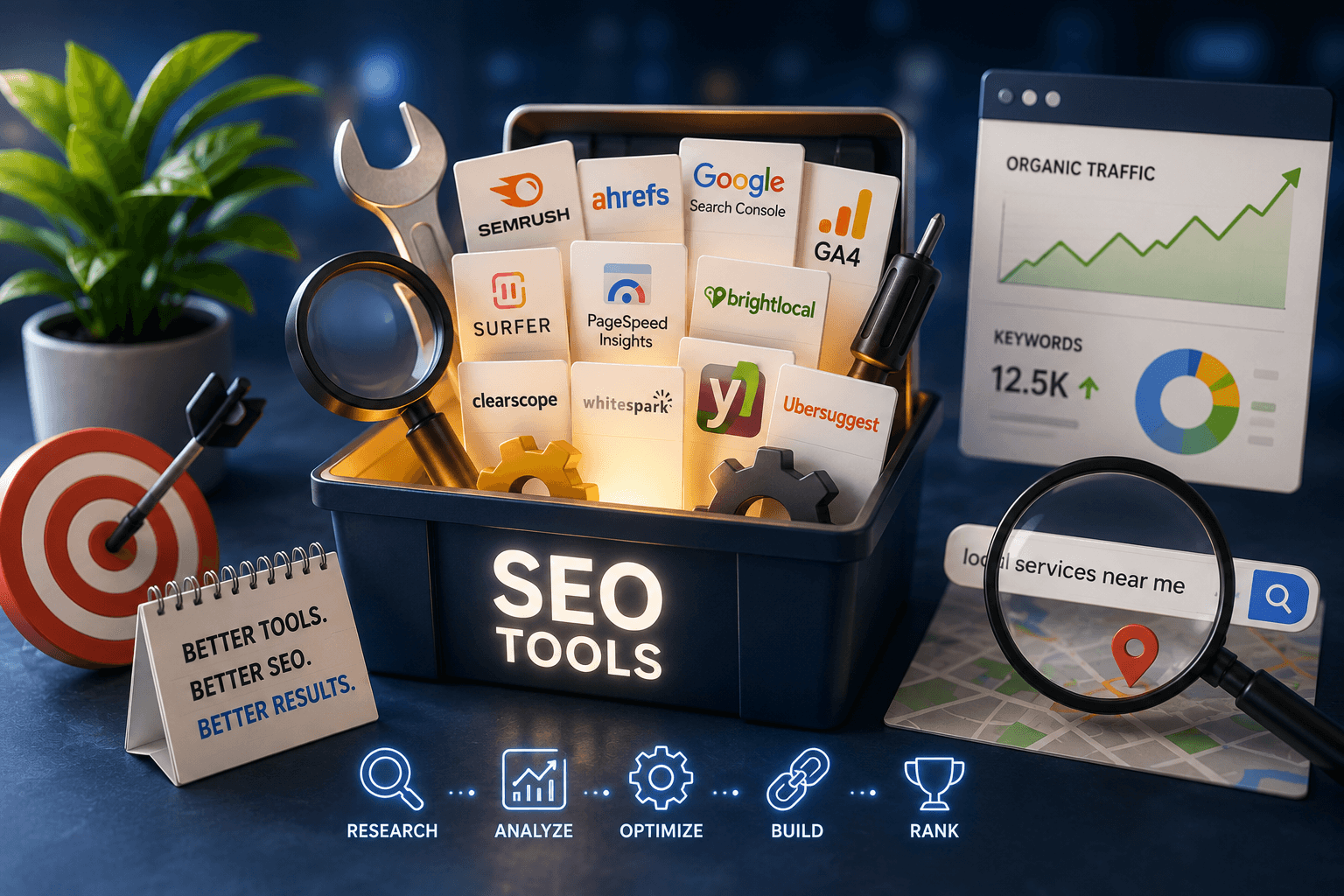
- The only essential free tools are Google Search Console and Google Analytics (GA4). Every other meaningful SEO tool requires a paid subscription.
- Ahrefs is the single most valuable paid SEO tool for keyword research, competitor analysis, backlink tracking, and rank monitoring. If you invest in one tool, make it Ahrefs.
- Screaming Frog is the gold standard for technical SEO audits. The free version crawls up to 500 URLs, which covers most small business sites.
- You don't need every tool on this list. A small business doing DIY SEO needs 3-4 tools. An agency managing multiple clients needs 6-8.
- AI-powered SEO tools are growing rapidly but haven't replaced the fundamentals. Use them to speed up workflows, not to replace strategy.
- The best tool is the one you actually use consistently. A comprehensive tool you check monthly is less valuable than a simple one you check daily.
Essential free tools everyone needs
Before spending a dollar on paid tools, these two free Google products should be set up and monitored weekly:
1. Google Search Console (GSC). This is your direct line to Google. It shows which keywords drive impressions and clicks, which pages are indexed, crawl errors, Core Web Vitals scores, and manual actions. Every SEO decision starts with GSC data. If you're not checking it weekly, you're flying blind. It's also the only tool that shows your actual Google performance, not estimates.
2. Google Analytics 4 (GA4). Tracks what happens after someone reaches your site: which pages they visit, how long they stay, whether they convert. GA4's acquisition reports show organic traffic separately from paid, social, and direct, so you can measure SEO's contribution to leads and revenue.
Setup tip: Connect GSC and GA4 together through GA4's Search Console integration. This lets you see keyword-level data alongside on-site behavior in a single dashboard.
Best all-in-one SEO platforms
These platforms combine keyword research, rank tracking, site auditing, and competitor analysis in one subscription:
1. Ahrefs ($129-449/month). This is the tool our agency relies on most. Ahrefs has the largest backlink index in the industry, the most accurate keyword difficulty scores, and the cleanest interface. We use it for keyword research, competitor analysis, backlink monitoring, content gap analysis, and rank tracking. If you invest in one paid SEO tool, make it Ahrefs. Its Site Audit feature catches technical issues that other tools miss, and Keywords Explorer provides the data behind every keyword strategy we build.
2. SEMrush ($139-499/month). SEMrush offers similar capabilities to Ahrefs with stronger paid ads analysis. It's particularly good for competitive intelligence, position tracking, and its Content Marketing Toolkit. Some agencies prefer it for the Advertising Research feature that shows competitor ad strategies.
3. Moz Pro ($99-599/month). The most beginner-friendly option. Moz pioneered Domain Authority (DA) scoring and offers solid keyword tracking and on-page optimization suggestions. It's a good starting point for businesses doing DIY SEO who find Ahrefs or SEMrush overwhelming.
Our recommendation: Ahrefs for agencies and serious marketers. SEMrush if you need integrated PPC analysis. Moz if you're a small business owner handling SEO yourself.
Best technical SEO tools
1. Screaming Frog SEO Spider (Free up to 500 URLs / $259/year unlimited). The industry standard for technical crawling. It identifies broken links, redirect chains, duplicate content, missing meta tags, orphan pages, and dozens of other technical issues in minutes. Our team runs a Screaming Frog crawl on every new client within the first week. The free version handles most small business sites. The paid version adds JavaScript rendering, crawl scheduling, and Google integrations.
2. Google PageSpeed Insights (Free). Tests individual page speed and Core Web Vitals. It shows exactly what's slowing your pages down (unoptimized images, render-blocking scripts, excessive DOM size) with prioritized recommendations. Test your top 5 pages and fix anything scoring below 80 on mobile.
3. Ahrefs Site Audit (included with Ahrefs subscription). A cloud-based crawler that runs scheduled audits and tracks technical health over time. It catches issues Screaming Frog finds plus some Ahrefs-specific insights around internal link distribution and content quality scores.
Best keyword research tools
1. Ahrefs Keywords Explorer. The most reliable keyword research tool available. Shows search volume, keyword difficulty, click metrics, traffic potential, parent topics, and SERP overview for any keyword. The "Matching terms" and "Related terms" reports surface thousands of keyword ideas from a single seed term. We use this for every content calendar we build.
2. Google Keyword Planner (Free with Google Ads account). Google's own keyword tool provides search volume ranges and CPC data. Volume data is less granular than Ahrefs (showing ranges like "1K-10K" instead of exact numbers), but it's free and based on actual Google data. Best used alongside a paid tool for validation.
3. AnswerThePublic (Free limited / $99/month). Visualizes questions people ask around any topic. Excellent for finding FAQ content ideas, People Also Ask opportunities, and long-tail question keywords. We use it to identify question-based content opportunities that feed into blog strategies.
Best content optimization tools
1. Clearscope ($170-350/month). Analyzes top-ranking content for your target keyword and recommends topics, terms, and depth to include. It's the closest thing to a "content recipe" for ranking. We use Clearscope to validate content briefs and ensure our articles cover the semantic breadth that Google expects for each keyword.
2. SurferSEO ($89-219/month). Similar to Clearscope but with more granular on-page recommendations: word count targets, heading suggestions, keyword density, and NLP term coverage. The Content Editor provides a real-time optimization score as you write. Good for writers who want step-by-step guidance.
3. Grammarly (Free / $30/month Premium). Not an SEO tool per se, but clean writing is a ranking factor by proxy. Google's helpful content system rewards content that's clear, well-structured, and readable. Grammarly catches awkward phrasing, passive voice, and readability issues that affect user engagement.
Best link building and outreach tools
1. Ahrefs Backlink Analysis. Monitors your backlink profile, identifies new and lost links, and shows competitor backlink profiles for prospecting. The "Link Intersect" feature reveals sites that link to your competitors but not to you, providing ready-made outreach targets. Essential for any link building strategy.
2. Hunter.io ($49-399/month). Finds verified email addresses for outreach targets. When you identify a site you want a backlink from, Hunter finds the right contact person and their email. It also has a free tier (25 searches/month) that works for small-scale outreach.
3. Pitchbox ($550+/month, agency-level). An outreach management platform that automates prospecting, email sequences, and follow-ups for link building campaigns. This is an agency-level tool, not necessary for businesses managing their own link building, but essential for scaling outreach across multiple clients.
Best local SEO tools
1. Google Business Profile (Free). The most important local SEO tool is free. Your GBP controls how you appear in the Map Pack, what information searchers see, and where your reviews live. Optimizing every field, posting regular updates, and responding to reviews are fundamental to local SEO success.
2. BrightLocal ($39-59/month). Purpose-built for local SEO. Tracks local rankings, monitors citations across directories, audits your Google Business Profile, and generates white-label reports. Their Citation Tracker identifies inconsistencies in your NAP (name, address, phone) across the web, which is a common issue that suppresses local rankings.
3. Whitespark ($39-149/month). Specializes in local citation building and local rank tracking. Their Local Citation Finder identifies where your competitors are listed that you're not, providing a straightforward list of directories to submit to. Also useful for finding local link building opportunities.
For a deeper dive on why local SEO matters, see the benefits of local SEO for small businesses.
Best rank tracking tools
1. Ahrefs Rank Tracker (included with subscription). Tracks keyword positions daily with location-specific results. Shows SERP features, position history, and competitor comparisons. Integrated with the rest of Ahrefs' data makes it our primary tracking tool.
2. AccuRanker ($129+/month). Dedicated rank tracking with on-demand updates (most tools update daily; AccuRanker lets you check positions in real time). Useful when you need to see the immediate impact of changes. Supports local tracking, SERP feature monitoring, and share of voice metrics.
3. Google Search Console (Free). GSC shows your average position for every keyword you appear for. It's not a traditional rank tracker (positions are averaged over a date range), but it's the most accurate source of position data because it comes directly from Google.
How to choose the right tools for your needs
You don't need all 12 tools. Here's what we recommend based on your situation:
Small business doing DIY SEO ($0-200/month):
- Google Search Console (free)
- Google Analytics 4 (free)
- Screaming Frog free version (500 URLs)
- Ahrefs Starter plan ($29/month) or Ubersuggest ($29/month)
Growing business with dedicated marketing ($200-500/month):
- Everything above, plus:
- Ahrefs Standard plan ($129/month) for full keyword research and competitor analysis
- SurferSEO or Clearscope for content optimization
- BrightLocal if you need local SEO ($39/month)
Agency or enterprise ($500+/month):
- Ahrefs Advanced plan ($449/month)
- Screaming Frog paid ($259/year)
- Clearscope for content ($170/month)
- Pitchbox or similar for outreach ($550+/month)
- BrightLocal for local clients ($59/month)
Final takeaway: Tools support strategy, they don't replace it
The best SEO tools in 2026 are more powerful than ever. But a tool is only as good as the strategy behind it. Ahrefs can show you every keyword your competitors rank for. It can't tell you which ones matter most for your specific business goals.
Tools provide data. Strategy turns that data into decisions. The businesses that get the most from their SEO tools are the ones who pair them with clear objectives: target keywords, content plans, technical priorities, and measurable goals.
At Lantern Sol, we use every tool on this list across our client base. The difference isn't the tools. It's knowing which data to act on, in what order, and why. That's what turns a subscription into revenue growth.
Explore our SEO services to see how we turn tool data into strategy. Or start with a free SEO audit to see what the tools reveal about your site's current state.
Want an expert team using these tools for your business? Explore our SEO services.
Ready to grow your business?
Get expert guidance tailored to your goals — let's build your growth plan together.
Book a Strategy Call