How to Rank in AI Overviews: The Ecommerce Guide to Zero-Click SEO

Key takeaways
- AI Overviews now appear on an estimated 47–64% of Google searches, reshaping how shoppers discover ecommerce brands.
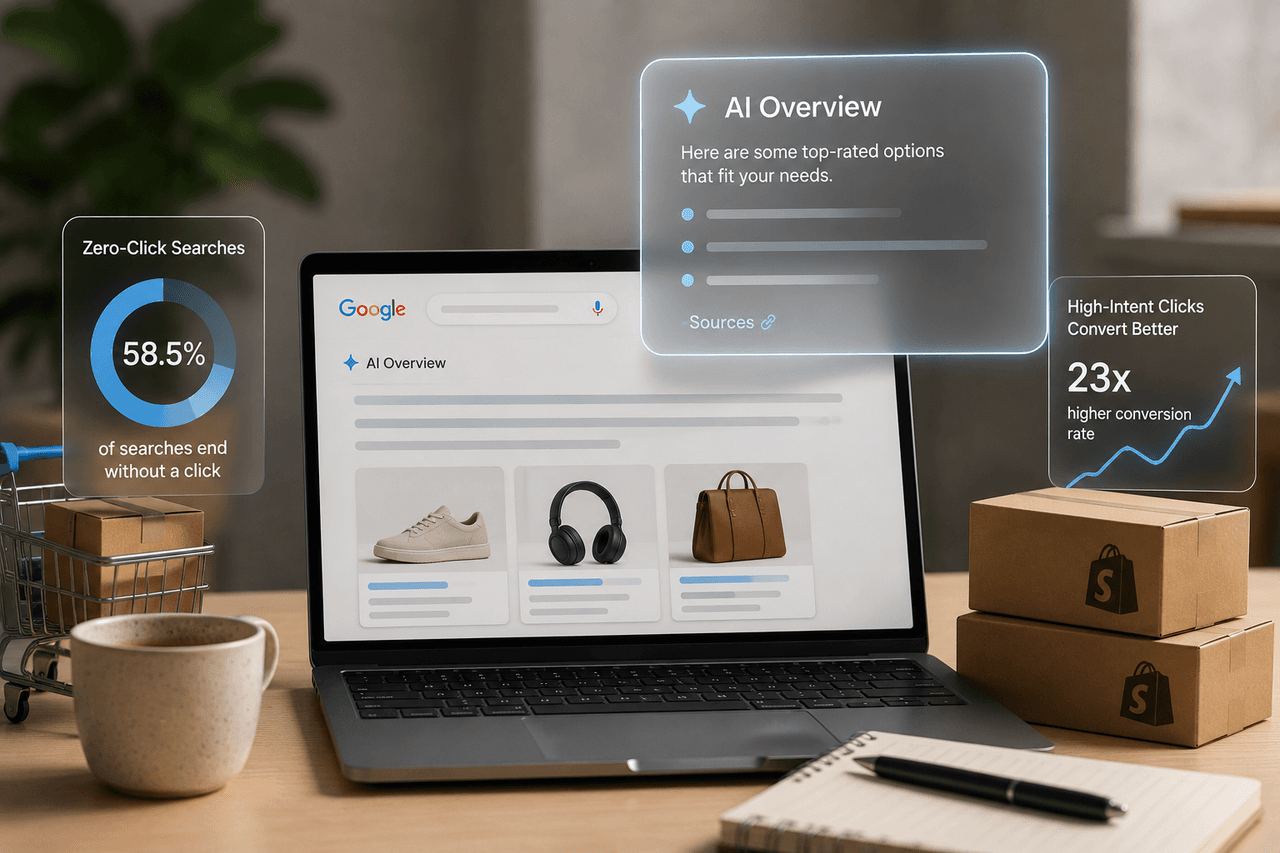
- 58.5% of searches now end without a click — but the visitors who do click through from AI Overviews convert at up to 23x higher rates.
- Only 38% of AI Overview citations come from pages ranking in the top 10, so traditional rankings alone no longer guarantee visibility.
- The three pillars of getting cited are structured data, entity authority, and citation-worthy content that adds new information.
- Google’s March 2026 core update specifically weighted “information gain” — content that repeats what already ranks won’t get cited.
- Zero-click search isn’t the death of SEO. It’s the death of low-intent traffic, and the traffic that remains is the most valuable you’ve ever earned.
If you run an ecommerce store, you’ve felt the ground shift. AI Overviews now sit at the top of most Google results, answering questions before anyone clicks, and the traffic reports look scarier every month. The instinct is to treat this as an existential threat to SEO. It isn’t — but the old playbook of ranking to collect clicks no longer works on its own.
This guide is the tactical version, written for marketers who already know what AI Overviews are and want to know how to get cited in them. We’ll cover what the shift actually means for ecommerce, why zero-click search is filtering your traffic rather than killing it, the concrete steps to earn citations, and how to measure whether any of it is working.
What AI Overviews Mean for Ecommerce SEO
AI Overviews — the AI-generated answers Google places at the top of the results page — now appear on an estimated 47–64% of searches. For informational queries, they’ve driven traffic declines of 20–40% as Google answers the question before the user ever reaches a link. If you measure success purely by raw sessions, that looks like a crisis.
It isn’t. This is opportunity disguised as disruption. The traffic that still comes through is dramatically higher quality, because AI Overviews absorb the low-intent “just looking” clicks and pass along the ones with real purchase intent. The strategic shift for ecommerce is from “rank to get clicks” to a two-part goal: get cited to build authority, and earn the highest-intent clicks that remain. The brands winning right now understand that being referenced inside an AI Overview is its own form of visibility, even when it doesn’t produce an immediate click.
For ecommerce specifically, the impact splits cleanly along the funnel. Informational queries — “how does X work,” “what should I look for in Y” — are the ones AI Overviews answer outright, so those lose clicks. Transactional and product queries — “buy X,” “best Y for under $50,” “X vs Y” — still send shoppers to stores, because no one commits to a purchase from a summary alone. Knowing which of your pages sit on each side of that line is the first step to defending the traffic that actually converts.
Why Zero-Click Search Isn’t the End of SEO
The doom narrative around zero-click search treats it as something new that AI invented. It isn’t. Zero-click results have existed for years in the form of knowledge panels, weather boxes, and featured snippets. What AI Overviews changed is scale, not the underlying dynamic. Today, 58.5% of searches end without a click — but the people with buying intent still click through to compare, verify, and purchase.
This distinction matters enormously for ecommerce. Product and collection queries — the searches closest to a purchase — still drive clicks, because a shopper comparing options wants to see the actual product, price, and reviews. It’s the informational, top-of-funnel queries that are going zero-click. And here’s the number that reframes the whole conversation: visitors who click through from an AI Overview convert at up to 23x higher rates than average. Zero-click SEO isn’t erasing your traffic — it’s filtering out the browsers and handing you the buyers. If you’ve been questioning whether your website still needs SEO in an AI-first world, this is the answer: it needs it more, just aimed at a different target.
Consider two searches. Someone typing “what is a French press” is satisfied by an AI Overview and rarely clicks — that person was never a buyer. Someone typing “best insulated French press under $50” is comparing real products and still clicks through to see them. The first query going zero-click costs you nothing you were going to convert; the second still lands on your collection page. Once you view your traffic through that lens, the panic fades and the strategy gets obvious: defend and sharpen the commercial queries, and use the informational ones to earn citations and authority.
How to Get Cited in AI Overviews
Getting referenced inside an AI Overview is a discipline of its own. Because only 38% of citations come from top-10 pages, you can’t rely on rankings alone — you have to make your content the clearest, most trustworthy source on a specific question. Here are the five tactics that move the needle.
Create Content That Directly Answers Specific Questions
AI Overviews are built to answer questions, so the content most likely to be cited answers a specific question directly and early. Target the exact “People Also Ask” questions in your niche, and put a clear, definitive answer in the first two or three paragraphs of the page — before any preamble. If someone searches “what size air purifier for a bedroom,” the citable page leads with the answer, then supports it. Burying the answer under 400 words of throat-clearing is how you get passed over for a competitor who got to the point.
Practically, mine the “People Also Ask” box and autocomplete suggestions for your category, then build pages or sections that answer each question in a self-contained way. Use the question itself as a heading, answer it in the first sentence beneath, and keep that answer quotable — a clean 40-to-60-word passage an AI Overview can lift without editing. Depth still matters below the fold, but the citable answer needs to live up top where a model will find it first.
Use Structured Data to Help Google Understand Your Content
Structured data removes ambiguity, and AI systems favor sources they can parse confidently. Prioritize FAQ schema for question-and-answer content, Product schema for your catalog, and Article schema for your blog and guides. This is the same machine-readability that drives strong ecommerce search performance — we break down how structured data drives Shopify SEO and, for implementation specifics, our Shopify schema markup guide covers exactly what to deploy. One prerequisite underneath all of it: your pages have to be crawlable and indexed in the first place, so resolve any Google indexing problems before you expect citations.
Don’t over-engineer it. Deploy the schema types that match what a page actually is, validate them in Google’s Rich Results Test, and keep the markup in sync with what’s visible on the page — mismatched or fabricated schema does more harm than none. Clean, accurate structured data on the pages that matter beats exhaustive markup on pages no one searches for.
Build Topical Authority Within Your Niche
AI models weigh how comprehensively a domain covers a subject, not just how good a single page is. Build topical authority by covering your niche thoroughly across formats — blog posts, service pages, and product pages that all reinforce the same core topics and interlink naturally. When your entire site consistently demonstrates expertise in one area, individual pages inherit that credibility. Our case study on how we outranked Amazon through content depth and structure is a working example of topical authority beating raw domain size.
The mechanism here is internal linking as much as sheer volume. When your buying guide, your service page, and your product pages all reference and link to one another around a shared theme, you build a web of context that signals genuine subject coverage. One strong page can rank; an interlinked cluster is what earns citations, because it tells Google your expertise runs deeper than a single article.
Include Original Data, Statistics, and Expert Perspective
This is the tactic most brands skip, and it’s the one that increasingly separates cited sources from ignored ones. AI models can already generate generic summaries on their own — what they can’t generate is your proprietary data, your case study results, or a genuinely original angle. Publish the numbers only you have: conversion benchmarks from your customers, results from your own tests, survey data from your audience. Original information gives an AI Overview a reason to cite you specifically rather than paraphrasing the consensus.
It doesn’t take a research department. A single honest data point — “across 40 of our ecommerce clients, adding FAQ schema lifted qualified organic clicks by an average of 18%” — is exactly the kind of specific, sourced claim an AI Overview reaches for, precisely because it can’t invent it. Audit what you already measure internally and turn it into publishable, attributed insight.
Optimize for E-E-A-T Signals
Experience, Expertise, Authoritativeness, and Trust are how Google decides which sources are safe to surface, and AI Overviews lean on the same signals. Strengthen them deliberately: publish real author pages with credentials, keep a substantive About page that establishes who you are, display industry certifications and affiliations, and earn third-party mentions from reputable sites in your space. These signals tell both Google and its AI systems that your content comes from a credible entity worth quoting.
For ecommerce brands, trust signals also live on the product itself: genuine customer reviews, clear return and shipping policies, and verifiable business information all reinforce that you’re a real operation rather than a drop-shipped storefront. AI systems increasingly weigh these commerce-specific trust markers when deciding which stores are safe to recommend.
What to Stop Doing: Tactics That Hurt AI Overview Visibility
Some habits that once felt harmless now actively suppress your visibility. Stop these:
- Publishing thin content that rehashes the top 10. The March 2026 core update rewarded “information gain” — content that adds new knowledge. If your page only restates what already ranks, it gives an AI Overview no reason to cite it.
- Keyword stuffing. Repeating a phrase to hit a density target reads as low-quality to the exact language models deciding what to cite. Write for clarity, not keyword counts.
- Publishing without an expertise signal. Anonymous, credential-free content struggles to earn citations because it fails the trust test. Attribute your content to real people with real authority.
- Ignoring structured data. Without schema, you force AI systems to guess at your content. Some guess wrong, and many default to a competitor they can read more confidently.
How to Measure Your AI Overview Performance
Measurement in this space is still maturing, but you have real tools today. Start in Google Search Console, where you can filter impressions to understand where you’re appearing and watch how click-through behavior shifts as AI Overviews expand. Layer in Ahrefs Brand Radar to track how often AI systems cite your brand, and run manual checks by asking ChatGPT and Perplexity the questions your customers ask to see whether you’re referenced.
The most important comparison is before-and-after: measure traffic and, crucially, conversion rate on your key pages against the period before AI Overviews took hold. If total sessions dip while conversion rate climbs, the channel is doing exactly what it should — sending you fewer, better-qualified visitors. Judge AI Overview performance by the quality of the traffic it delivers, not the raw volume it filters out.
Set a simple monthly cadence: log your AI Overview impressions and citation counts, note every query where a competitor is cited and you aren’t, and treat each of those gaps as a content assignment. Over a quarter, that running list becomes the most honest roadmap you have for where to earn visibility next.
Final Takeaway
AI Overviews are quietly filtering out low-intent traffic and routing the highest-quality clicks to the sites that earn citations. That’s not a threat to ecommerce SEO — it’s a reweighting of it toward exactly the visitors who buy. The brands adapting fastest treat AI visibility as a core SEO deliverable, built into structured data, topical authority, and original content, rather than a side project bolted on later.
If you want your store cited in AI Overviews and capturing the high-intent clicks that remain, our SEO services are structured around this exact shift. To see where your site stands today, start with a free ecommerce SEO audit and we’ll show you the gaps between where competitors get cited and where you don’t.
Want your brand cited in AI Overviews?
Build an ecommerce SEO strategy designed to earn AI citations, strengthen your search visibility, and attract the high-intent traffic that converts.
Get Your Free SEO Audit