How to Rank in Google AI Overviews


Key takeaways
- AI Overview prevalence can vary substantially. A Semrush study of more than 10 million keywords found that AI Overviews appeared for 6.49% of keywords in January 2025, peaked at 24.61% in July, and declined to 15.69% in November.
- Traditional SEO remains an important foundation for earning citations in AI Overviews. A 16-month study found that 54% of sources cited in AI Overviews also appeared in Google’s organic results, up from 32% at the beginning of the study.
- Clear headings followed by concise answers make important information easier for search systems to identify and use.
- Google uses query fan-out to run multiple related searches, so thorough topic coverage can help a page surface for the broader questions behind a query.
- Strong trust signals—including accurate sourcing, author credentials, first-hand subject knowledge, and mentions on credible websites—can support both organic rankings and AI visibility.
- AI Overviews can reduce clicks to organic results. An Ahrefs analysis of 300,000 keywords found that the top-ranking page received 58% fewer clicks when an AI Overview appeared.
Enter a question into Google today, and you may see an AI Overview above the traditional results. An AI Overview an AI-generated summary that draws from multiple web sources to answer the query directly.
AI Overviews were officially launched for all U.S. users on May 14, 2024 and have since expanded to more than 200 countries and over 40 languages. Their prevalence varies. A Semrush study of more than 10 million keywords found that the share triggering them ranged from 6.49% to 24.61% during 2025.
When an AI Overview appears above the organic results, earning a citation gives your brand visibility in the answer searchers see first. The good news is that learning how to rank in AI Overviews starts with familiar SEO fundamentals.
This guide explains how traditional rankings, content structure, topical coverage, and brand authority can improve your chances of being cited. If your SEO services don't yet account for AI visibility, this is where to start.
What are Google's AI Overviews?
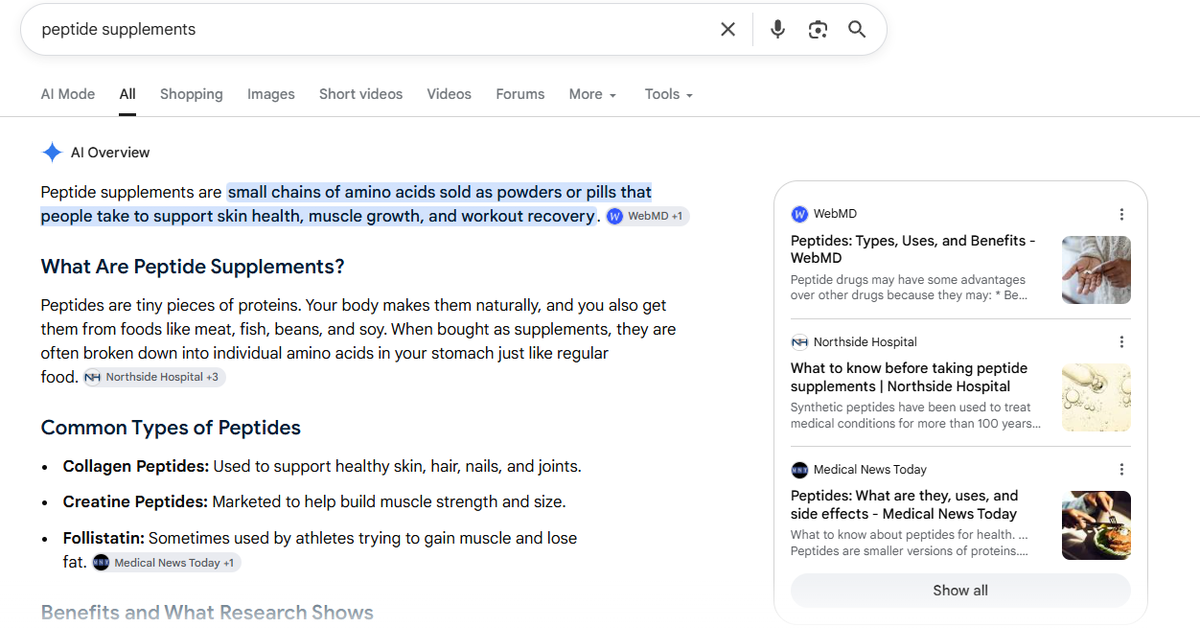
AI Overviews are summaries generated from information Google finds across multiple web sources. They may include explanatory text, lists, images, product suggestions, and links to pages that support different parts of the answer.
Unlike a featured snippet, which usually highlights content from one page, an AI Overview can combine information from several sources. It may also use query fan-out, running related searches behind the scenes to address different parts of the original question. As a result, Google may cite a page that ranks for one of those related searches, even if it doesn't rank highly for the user’s original query.
And because the summary may answer the question directly, some users have less reason to visit the cited pages or the organic results below. This can contribute to zero-click searches, where the user completes a search without visiting another website.
How to improve your chances of appearing in AI Overviews: 5 strategies that help
There’s no guaranteed way to earn an AI Overview citation. However, the following practices can make your content easier for Google to find, understand, and use as a source.
1. Build on strong traditional SEO
Many pages cited in AI Overviews also appear in Google’s organic results for the original query or a related search. Technical SEO, on-page optimization, and organic visibility therefore remain an important foundation.
Featured snippets still appear in Google Search and offer a useful model for structuring answers. Both featured snippets and AI Overviews can surface content that answers a clear question directly, but earning one doesn’t guarantee the other. An AI Overview can also cite several sources, giving more pages an opportunity to appear.
Featured snippets | AI Overviews | |
Sources cited | Usually one page | Multiple sources |
Placement | Above or among organic results | Above organic results |
What it does | Highlights a concise answer | Combines information from several pages |
What may help | A direct answer beneath a clear heading | Clear answers, broader topic coverage, and credible supporting information |
Traditional rankings and AI Overview visibility often go hand in hand. Strengthening a page’s organic performance can also improve its chances of being cited.
2. Make your content easy to understand and cite
Organize your content so readers and search systems can quickly identify the answer to each question. Clear headings, direct explanations, and supporting details make the page easier to follow and cite.
- Place a concise answer directly beneath the heading that introduces the question, then add context and supporting detail.
- Use clear, concise sentences and descriptive headings. Add lists or tables when they make the information easier to follow.
- Use relevant schema markup to provide additional context about the page and its content. Schema can support machine understanding, but it doesn't guarantee inclusion in an AI Overview.
- Keep important pages accessible, crawlable, and indexed. Google cannot consider content it cannot reach or include in its index.
- Support important claims with credible sources, original data, or first-hand expertise where appropriate.
Review older content periodically and update it when information changes or important details are missing. A useful refresh improves the page’s accuracy, completeness, and clarity.
3. Cover the related questions behind the search
Because AI Overviews use query fan-out, they may draw from pages that address different aspects of the original query.
For example, a search for “best running shoes for beginners” could lead Google to look for information about cushioning, fit, foot type, running surface, and price. Your content should cover the relevant comparisons, explanations, conditions, and next steps a reader may need.
The goal isn’t to include every possible subtopic. Focus on the questions that help readers understand the subject or make a decision. Relevant FAQ sections, supporting pages, and internal links can provide additional depth without forcing everything into one article.
This broader approach is part of generative engine optimization (GEO): making your brand and content easier for AI-powered search systems to understand, retrieve, and cite.
4. Give readers and search systems reasons to trust you
Strong content is easier to trust when readers and search systems can verify who created it, where its claims came from, and what experience supports it.
Google’s E-E-A-T framework—experience, expertise, authoritativeness, and trustworthiness—offers a useful way to evaluate these signals, especially for topics that could affect someone’s health, finances, or safety.
- Earn relevant mentions and links from credible websites in your industry.
- Identify authors and include credentials or first-hand experience when these details help establish subject knowledge.
- Support factual claims with reliable sources, original research, or evidence from your own work.
- Keep important business details consistent across your website and other online profiles.
- Contribute useful information where your audience researches and compares options, such as industry publications, review sites, and relevant communities.
These signals cannot compensate for weak content. They help establish why readers, and potentially search systems, should consider the information credible.
5. Measure your AI Overview visibility
AI Overview citations require separate tracking alongside your traditional SEO metrics. Add AI visibility to your regular reporting so you can see where your pages appear as sources.
Review Google Search Console data
Look for queries that continue receiving similar impressions but fewer clicks. This may mean that an AI Overview may be answering the query directly and reducing the need to click your result. Search Console does not report AI Overview performance separately, so treat this pattern as a reason to investigate.
Track AI Overview appearances
Use tools such as Semrush Position Tracking, Ahrefs Rank Tracker, or seoClarity to identify which keywords trigger AI Overviews and whether your pages appear among the cited sources. Features and reporting limits vary by platform and plan.
Monitor a consistent set of queries
Choose questions that reflect how customers research, compare, and evaluate your products or services. For example, a skincare brand might regularly track “What’s the best moisturizer for dry skin?” and “How do ceramides help the skin?”
Checking the same queries over time makes changes in citations and brand mentions easier to spot.
Record more than citations
Track brand mentions, cited pages, competitors, organic rankings, impressions, clicks, and click-through rates. A citation shows that your content appeared as a source, but it doesn’t reveal whether the AI Overview mentioned your brand, attracted clicks, or improved your overall search visibility.
Reviewing these metrics together gives you a clearer picture of what that appearance contributed.
Review the results monthly
AI Overview sources can change frequently, so regular checks can help you identify gains, losses, and pages that may need further work. For example, if a page loses citations for several tracked queries while a competitor begins appearing, compare the two pages for gaps in coverage, sourcing, or freshness.
If you’re not sure where to begin, get a free ecommerce SEO audit. We’ll review your store’s search visibility and identify the technical and content opportunities worth prioritizing.
What to read next:
How to rank in AI Overviews: FAQs
How do you get your content into AI Overviews?
Answer the searcher’s question clearly and support the answer with specific, verifiable information. Define the problem, place a concise answer beneath the relevant heading, and provide evidence such as reliable sources, original research, first-hand experience, or clearly attributed claims.
Strong organic SEO, relevant schema markup, comprehensive topic coverage, credible backlinks, and consistent brand information may also improve your chances. No individual tactic guarantees inclusion.
Do featured snippets help you appear in AI Overviews?
They can indicate that your content is structured to answer a question clearly, but they do not directly lead to an AI Overview citation. The two formats may favor similar qualities, such as descriptive headings, concise answers, and information that directly addresses the query.
Earning a featured snippet does not guarantee an AI Overview citation, and the reverse is also true.
Does content need to rank in traditional search first?
Not necessarily. Many cited pages also appear in organic results, but a page does not always need to rank highly for the exact query. Through query fan-out, Google may find and cite a page that performs well for a related search.
How do AEO and GEO relate to AI Overviews?
Answer engine optimization (AEO) focuses on helping content appear in direct answers, such as featured snippets and answer boxes. Generative engine optimization (GEO) focuses on helping brands and content earn mentions or citations in AI-generated responses, including AI Overviews.
The two approaches overlap. Both build on SEO fundamentals and emphasize clear answers, comprehensive topic coverage, verifiable claims, and well-organized content.
Do topic clusters help with AI Overview visibility?
A pillar-and-cluster model can help a site cover a subject without forcing every detail onto one page. A central pillar page addresses the main topic, while supporting pages explore related questions and link back to it.
This structure can strengthen topical coverage and give readers—and search systems—clear paths between related information.
Do backlinks and digital PR still matter for AI search?
High-quality backlinks remain valuable for organic SEO and can help establish a website’s authority. Digital PR can also earn brand mentions, expert citations, and coverage from credible publications, creating external evidence that supports the brand’s reputation across search and AI systems.
Neither guarantees an AI Overview citation, but both can strengthen the signals surrounding the content and the organization behind it.
How do AI Overviews affect website traffic?
AI Overviews can reduce clicks to organic results by answering part or all of the query directly. An Ahrefs analysis of 300,000 keywords found that, as of December 2025, an AI Overview was associated with a 58% lower click-through rate for the top-ranking page.
The effect won’t be the same for every page. It depends on the search query, the page’s organic position, and whether the AI Overview cites it. Compare citations with impressions, clicks, and conversions to see how AI Overviews may be affecting your site.
Want to appear in Google AI Overviews?
Strengthen your technical SEO, content structure, topical coverage, and authority signals to improve your chances of being cited in AI-powered search results.
Get Your Free SEO Audit