What Is AI SEO? The Complete 2026 Guide


Key takeaways
- AI SEO refers to two related practices. One is using AI to make SEO work faster and more efficient. The other is optimizing content so AI search tools cite it in their answers.
- AI search is changing how people discover brands. As AI answers replace more traditional search results, visibility depends on both strong SEO fundamentals and content that AI models recognize as trustworthy.
- AI works best as an assistant, not a replacement. It can speed up research, keyword clustering, and drafting, but human expertise is still essential for strategy, accuracy, and original insights.
- Traditional SEO and generative engine optimization work together. Helpful content, technical SEO, authority, and clear entity signals (consistent names for people, brands, products, and topics) improve your chances of ranking in search engines and being cited by AI.
- A successful AI SEO strategy combines automation with human judgment. Let AI handle repetitive tasks while people focus on decision-making, quality, and creating content that earns trust from both users and AI systems.
Ask 10 marketers what AI SEO means, and you'll likely get two different answers.
Half will tell you it's about using AI tools to speed up SEO tasks like drafting content, running keyword research, and auditing a site in minutes instead of days. The other half will say it's about getting your brand surfaced in AI-generated answers: ChatGPT responses, Google's AI Overviews, and the sources AI systems choose to cite.
Both groups are right, and that's where the confusion begins. "AI SEO" has become an umbrella term for two related but distinct disciplines. Knowing which one you're talking about determines the strategy to follow.
This guide breaks down both sides of AI SEO, shows how they fit together, and gives you a framework you can apply today, whether you run SEO in-house or partner with an SEO services provider.
What is AI SEO, exactly?
AI SEO refers to the practice of:
- Using artificial intelligence to improve search performance
- Optimizing your content so it earns visibility in AI search results
Using AI for traditional SEO
This is the version most people mean when they say they "use AI for SEO." AI helps with time-consuming tasks like clustering keywords, identifying content gaps, drafting outlines, generating meta descriptions, and analyzing Google Search Console data. The goal is speed and scale, freeing your team to spend more time on strategy, expertise, and decision-making.
In practice, AI is commonly used for:
- Keyword research at scale: Grouping relevant keywords by search intent and mapping them to pages instead of reviewing spreadsheets one keyword at a time.
- Content creation support: Turning a content brief into a structured first draft, then editing it for accuracy and voice.
- On-page optimization: Drafting titles, headings, and meta descriptions, while identifying thin or incomplete sections.
- Technical SEO triage: Analyzing crawl reports and Google Search Console data to surface indexing and visibility issues worth fixing first.
The catch: AI-generated content published without review is a liability. Search engines reward genuine expertise, and readers can usually tell the difference. AI belongs in the content creation process as a fast first drafter and research assistant, not the final author. A human should always own the facts, examples, and point of view.
Optimizing for AI search
The second side of AI SEO focuses on helping your content earn visibility in AI-generated answers. That discipline is known as generative engine optimization (GEO).
When someone asks ChatGPT for "the best SEO agency for a Shopify brand," the model decides which sources to trust and cite. Ranking well helps, but AI models also look for content that's clear, authoritative, and easy to understand and quote.
That means your content should:
- Lead with the answer: Put a clear, self-contained response in the first two sentences under each heading so it's easy to cite.
- Define concepts clearly: Use consistent names for people, products, companies, and topics (collectively known as entities) so AI models can recognize what your content is about.
- Build recognizable authority: Mentions, reviews, and backlinks help establish your brand as a trustworthy source.
- Track AI visibility: Monitor where AI search engines already mention your brand and where competitors are being cited instead.
Done well, GEO and traditional SEO reinforce each other. The same helpful, authoritative content that performs well in traditional search is often the content AI models trust and cite. AI SEO isn't replacing SEO—it's expanding what successful SEO looks like.
Why AI SEO is reshaping search
AI Overviews have become a routine part of Google Search. Independent studies estimate they appear in anywhere from roughly one in seven to one in four searches, depending on the query set being measured. Google says AI Overviews now reach more than 2 billion monthly users, and inside Google's fully conversational AI Mode, the overwhelming majority of sessions end without a click to an outside website.
Traditional search is sending fewer visitors on informational queries because the answer increasingly lives on the results page itself. The visitors who do click through from AI answers, however, tend to arrive with higher intent. They've already seen your brand recommended before they land, so they often engage more and bounce less than other visitors.
That trade only pays off if you're the source getting cited, making AI citations as important as traditional rankings.
If you're still deciding whether SEO deserves a place in your marketing budget, we explain the business case in 6 signs you're losing leads without SEO.

AI SEO built on SEO fundamentals
It's tempting to treat AI SEO as a brand-new rulebook. It isn't. AI models still rely on the same signals SEO professionals have optimized for years: helpful content, technical strength, and authority. If your fundamentals are weak, no amount of AI-driven SEO tooling can compensate.
- Helpful, original content: Depth, genuine expertise, and clear answers to user intent help pages rank in search and earn citations in AI-generated answers. Same bar, two audiences.
- Technical strength: Crawlable, fast, mobile-ready pages with a clean structure give search engines and AI models the foundation they need to access and understand your content. If you sell online, an ecommerce SEO audit can quickly uncover the technical issues holding your rankings back.
- Authority and entities: Backlinks, brand mentions, and consistent entity signals help search engines and AI models recognize your brand as a trusted source.
This is why AI SEO still benefits from human expertise. If you're deciding between doing it yourself and hiring help, our breakdown of what an SEO agency does explains where expert guidance adds value.
AI SEO optimization: A framework that works
The most effective AI SEO strategies combine AI-assisted workflows with human expertise.
- Start with intent, not volume: Use AI SEO tools to cluster target keywords by user intent, then prioritize the clusters closest to a sale.
- Brief tightly, draft with AI: Feed the model a real content brief—your angle, target audience, and the questions the page needs to answer—then let it produce a structured first draft.
- Edit for expertise and voice: A human adds real examples, checks every claim, and rewrites for brand voice. This is the 70% that keeps AI-generated content from reading like everyone else's.
- Optimize the page for search engines and AI: Lead with clear answers, use descriptive headings, strengthen internal links, and organize information so it's easy for both people and AI models to understand.
- Measure, then iterate: Use Google Search Console to monitor search performance, and track brand citations across AI platforms. Update pages that begin to lose visibility.
Turn AI search into a lead channel
AI didn't kill SEO. It raised the bar. Brands that succeed today understand that AI and SEO work best together. Earning visibility in AI-generated answers still depends on the same fundamentals that drive strong search performance, combined with a strategy built for how people search today. That's the approach Lantern Sol brings to every SEO engagement.
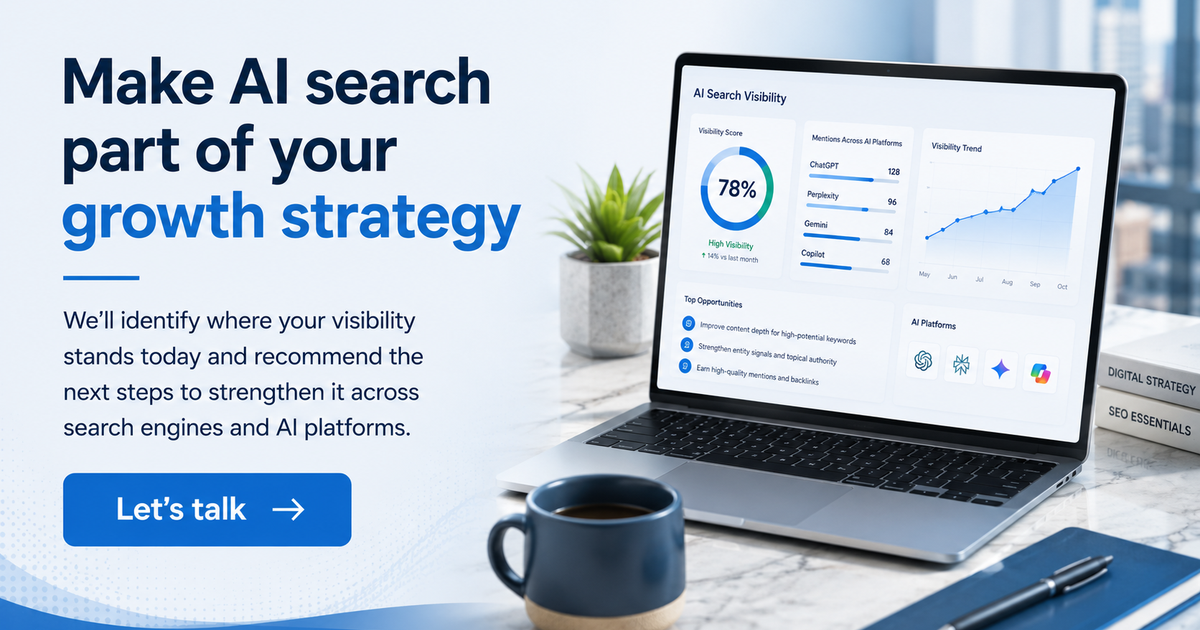
Want to see where your brand appears—and where it's missing—across Google and AI search? Book an AI SEO consultation, and we'll show you how to turn more searches into qualified leads.
AI SEO: FAQs
How can AI be used in SEO?
In two ways. Operationally, AI speeds up SEO tasks like keyword research, clustering by search intent, drafting content and meta descriptions, and pulling actionable insights from Google Search Console and other SEO tools. Strategically, you also optimize relevant content so it gets cited in AI-generated answers and AI Overviews.
Most teams get the best results by combining both: AI for repetitive tasks. Humans for strategy, expertise, and quality.
Will SEO be replaced by AI?
No, but it's changing shape. AI is automating the mechanical parts of SEO, so the value shifts toward strategy, expertise, and the authority that makes search engines and models trust you.
Demand for visibility isn't shrinking. It's splitting across Google and AI search platforms. Teams that combine AI-powered SEO with human judgment become more effective, not obsolete.
What is the 30% rule for AI?
In a content context, the 30% rule is a rule of thumb, not a Google policy, that AI should handle roughly the first 30% of the work (research, structure, and a first draft) while a human owns the remaining ~70%: the expertise, examples, fact-checking, and voice. The point is to capture AI's speed without shipping generic AI-generated content that search engine algorithms and readers can spot.
Is there an AI tool for SEO?
Many. The category spans AI-powered SEO tools for keyword research and content optimization, platforms that grade a draft against what's ranking, brand-monitoring SEO platforms that track your citations across AI search engines, and general AI tools like ChatGPT or Claude for drafting and analysis.
No single AI SEO tool does everything well, so most teams rely on a combination of tools rather than one all-in-one platform.
Can AI do SEO optimization?
AI can do a lot of SEO optimization: draft optimized copy, suggest on-page optimization fixes, cluster valuable keywords, and flag technical SEO issues at a speed no person can match.
What it can't do reliably is judge accuracy, add first-hand expertise, or own the strategy behind the work. So the honest answer is AI can execute much of the optimization, but it needs a human directing it and checking it. That partnership—machine speed, human judgment—is what AI SEO truly is.
Ready to make AI search work for your brand?
Build an AI SEO strategy that combines smarter automation with human expertise to improve your search visibility, earn AI citations, and turn more searches into qualified leads.
Book an AI SEO Consultation