Generative Engine Optimization (GEO): The Complete Guide


Key takeaways
- Generative engine optimization (GEO) is an approach to improving brand visibility across AI search and answer engines.
- GEO doesn’t replace SEO. AI systems retrieve from the same indexed web that search engines rank, so weak technical foundations hurt performance in both.
- Google AI Overviews are associated with a 58% lower average click-through rate for the top-ranking page. That makes visibility within AI answers increasingly important, even for pages that rank well.
- AI systems can find brand information across your own pages, third-party websites, structured data, and off-site brand mentions.
- Some of the strongest GEO opportunities come from third-party websites, particularly category roundups and unlinked brand mentions.
- Clear answers, statistics, credible citations, and structured data can make your content easier for AI systems to understand and cite.
- Track AI mentions, citations, share of voice, and conversions from AI referral traffic alongside traditional traffic metrics.
Google AI Overviews are linked to a 58% lower average click-through rate for the top-ranking page, according to updated research from Ahrefs. The ranking may still be there, but fewer searchers are clicking through. That shift is changing what it takes to stay visible in search.
GEO is the practice of improving your brand’s visibility in AI-generated answers across platforms such as ChatGPT, Perplexity, Gemini, Copilot, and Google AI Mode. The goal is to increase the chances that AI systems find, understand, mention, and cite your brand when answering relevant questions.
GEO doesn’t replace search engine optimization. It builds on many of the same foundations while accounting for a search experience where users may get an answer without clicking a traditional search result.
This guide covers what GEO is, how it differs from traditional SEO, where AI systems find information about brands, strategies that can improve your chances of earning citations, and how to measure AI visibility when rankings and organic traffic no longer tell the whole story.
What is generative engine optimization?
Generative engine optimization is the practice of improving your content, data, and off-site presence so your brand has a better chance of appearing in AI-generated answers.
GEO started as an academic idea before it became a marketing discipline. Researchers from Princeton University and IIT Delhi introduced the term in a study published at KDD 2024, where they tested what makes content more likely to surface in generative engine responses. Their experiments found that adding statistics, quotations, and credible citations could improve source visibility by up to 40%.
Those findings make more sense when you look at how AI search systems find and assemble information. Rather than relying on a single set of traditional ranking signals, they can retrieve information across multiple searches and sources before generating an answer. Google describes two techniques its generative AI search features use:
- Query fan-out: The system generates multiple related searches across subtopics and data sources to gather information relevant to the original question.
- Retrieval-augmented generation (RAG): Google retrieves relevant, up-to-date pages from its Search index and uses information from those sources to help generate its response.
Google Search Central explains both processes in its guidance for generative AI search.
For brands, that creates another opportunity for visibility. Your content can become one of the sources that informs or supports an AI-generated response.
The unit of success changes, too. In traditional SEO, you're trying to earn a prominent position in the search results. In GEO, you're also trying to earn a place within the generated answer, whether that's a brand mention, a cited claim, or a link to your content.
GEO vs. traditional SEO: How they compare
GEO isn't a replacement for SEO. Many of the same fundamentals still apply. Your content needs to be accessible, useful, authoritative, and easy for search systems to understand. Google, for example, says there are no additional technical requirements or special optimizations needed to appear in its AI Overviews or AI Mode beyond its existing Search requirements and SEO best practices.
Traditional SEO | Generative engine optimization | |
Goal | Gain visibility in search results | Gain visibility in AI-generated answers |
Unit of success | A prominent search position | A mention, citation, recommendation, or source link |
Key considerations | Search intent, content quality, technical SEO, links, authority | Clear answers, extractable information, consistent brand information, third-party authority |
Content approach | Satisfy search intent comprehensively | Make useful information clear and easy to extract while still satisfying search intent |
Measurement | Rankings, impressions, clicks, organic traffic, conversions | AI mentions, citations, share of voice, AI referral traffic, conversions |
Where visibility appears | Search results and SERP features | Generated answers, citations, source links, and recommendations |
What is AI share of voice?
AI share of voice measures how often your brand appears in AI-generated answers compared with your competitors for the same set of relevant prompts. For example, if your brand appears in 30% of the answers you track while a competitor appears in 50%, that comparison shows who has greater visibility across those queries.
As you can see, the overlap is substantial. GEO still depends on a strong search foundation, but it expands the focus beyond rankings and clicks to how your brand and content appear within AI-generated answers. In practice, that means making your information easy to understand and cite while also strengthening the third-party signals that help establish your brand across the web.
We break down the overlap and differences further in our guide to GEO vs. SEO.
Where AI systems find information about your brand
GEO extends beyond the content you publish on your own website. AI search systems can draw on information from across the web when generating answers, which means your visibility can also depend on how clearly and consistently your brand is represented elsewhere.
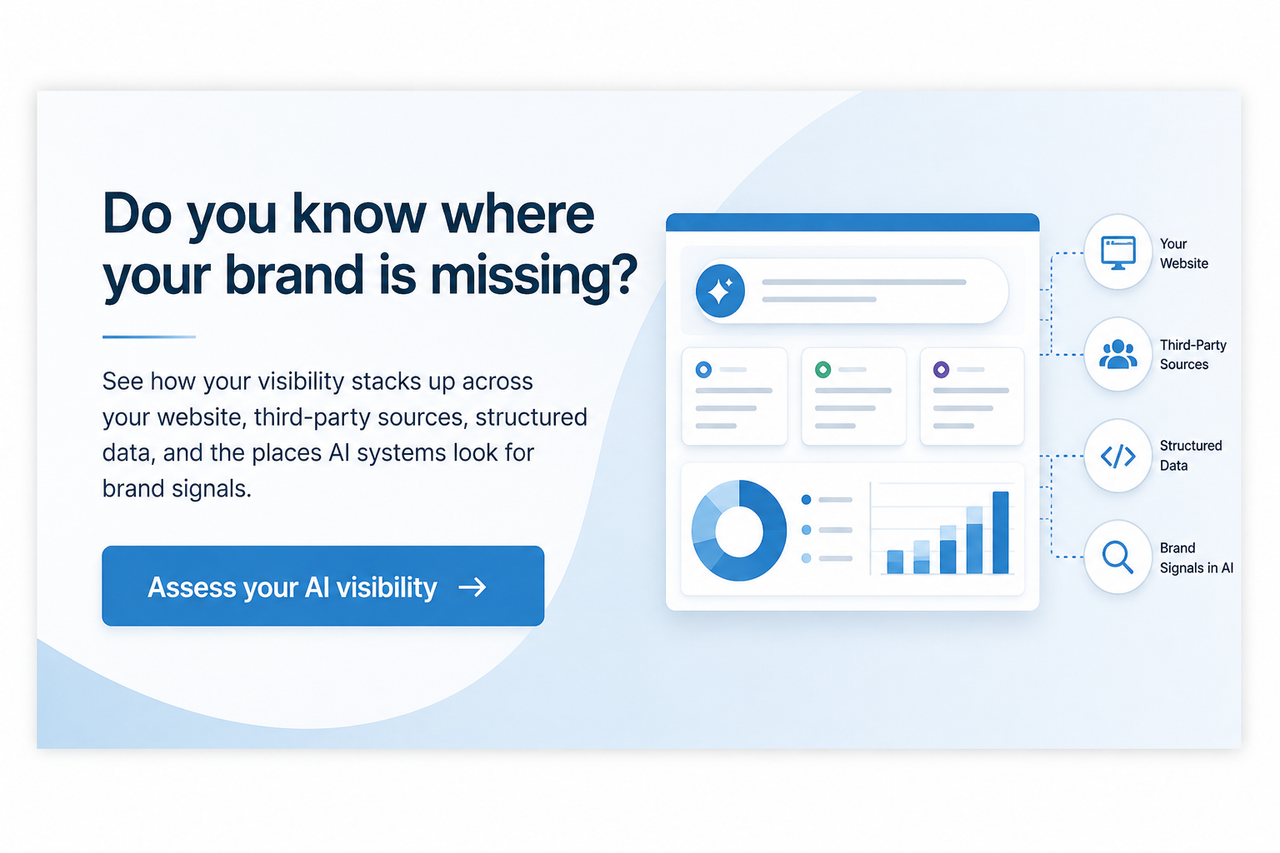
Four key sources of brand information can influence that visibility:
- Your website: Your product pages, category pages, articles, and other content establish what your brand offers and what topics it has expertise in. Clear, crawlable, well-structured content gives search and AI systems useful information to retrieve and cite.
- Independent websites: Roundups, comparison articles, reviews, industry publications, and other independent sources provide information about your brand from outside your own domain. These sources can be especially relevant when someone asks an AI system to compare products, companies, or providers.
- Structured data: Schema markup helps search systems understand your pages and identify the products, organizations, and other entities they describe. It should reinforce information that's visible on the page rather than introduce new information only through the markup.
- Community and media mentions: Press coverage, forums, Reddit discussions, YouTube content, podcasts, and other mentions expand your brand's presence beyond your own website. Depending on the platform and query, these sources may also appear among the information AI systems retrieve when generating answers.
The important point is that GEO isn't confined to on-site optimization. Your content may explain your brand clearly, but AI systems can also encounter independent sources that describe, compare, review, or discuss it. That makes third-party visibility and consistent brand information important parts of a broader GEO strategy.
Generative engine optimization strategies for improving AI visibility
GEO doesn't require a separate technical playbook. It builds on SEO fundamentals such as helpful content, crawlability, structured data, and off-site authority, with additional emphasis on making information easy for AI systems to retrieve, interpret, and cite.
- Answer the question directly: Give readers the main answer early, then provide the explanation and evidence. Clear, self-contained passages are easier to understand without relying on several paragraphs of context.
- Make content easy to scan: Use descriptive headings, short paragraphs, bullets, and tables where they help readers understand the information. Google recommends making important content available in textual form and creating pages that provide a good user experience.
- Support claims with specific evidence: Include relevant statistics, credible citations, quotations, and named sources where appropriate. The original GEO study found that adding statistics, quotations, and citations could improve source visibility in generated responses, although results varied by method and topic.
- Keep brand information consistent: Use consistent names and descriptions for your company, products, and services across your website and other online sources. This makes it easier for search systems to understand what those entities represent.
- Use relevant structured data: Add schema markup that accurately reflects the visible content on the page. Google says structured data can help its systems understand content, but there's no special schema required to appear in AI Overviews or AI Mode.
- Keep important content current: Review high-value pages periodically and update information that has become outdated. Rather than refreshing content on an arbitrary schedule, update it when there's something useful or substantive to change.
- Build third-party visibility: Relevant industry publications, comparison pages, reviews, expert contributions, and other independent sources can expand your brand's presence beyond your own domain.
- Check crawler access: Make sure your site isn't unintentionally blocking the AI crawlers you want to access your content. Crawler rules vary by AI platform, so check the requirements for the platforms you want to appear in.
GEO metrics: How to measure AI visibility
Traditional SEO metrics don't tell the whole story with GEO. Rankings and organic traffic still have value, but you also need to track whether your brand appears in AI-generated answers and what happens when people reach your site from those platforms.
Focus on four metrics:
- AI mentions: Track how often your brand appears for a consistent set of relevant prompts. Using the same prompts over time gives you a clearer picture of whether your visibility is changing.
- Citations: Track how often AI answers cite or link to your domain and which pages they reference. Platforms such as Semrush Enterprise AIO and Ahrefs Brand Radar can help monitor AI mentions and citations at scale.
- Share of voice: Compare how often your brand appears with how often your competitors appear for the same prompts. This shows whether your AI visibility is growing relative to others in your category.
- AI referral traffic: Use GA4 to track visits from ChatGPT, Perplexity, and other AI platforms. Look beyond session volume to engagement and conversions to understand the value of that traffic.
AI referral traffic is only one part of the picture. A user may encounter your brand in an AI answer without clicking the citation, then visit your site later through search or another channel. That’s why it helps to look at AI visibility, referral traffic, and conversions together.
Where to take this next
GEO expands search visibility beyond rankings and clicks. The next step is understanding where your brand appears in AI-generated answers, where competitors are being cited instead, and which gaps are worth addressing first.
If you want to see where your brand stands today, book a free strategy call. We’ll review your AI search visibility and help identify the opportunities worth prioritizing.
What to read next:
- How to Rank in ChatGPT: Understanding AI Search
- How to Rank in AI Overviews: The Ecommerce Guide to Zero-Click SEO
Generative engine optimization: FAQs
Is GEO replacing SEO?
No. GEO isn’t replacing SEO. It complements it. AI search still depends heavily on the crawled and indexed web, so technical problems or weak authority can limit your visibility in both traditional and AI search.
Treat GEO as an additional layer of your SEO strategy, with the same core foundations but a broader focus on mentions, citations, and visibility in AI-generated answers.
Is generative engine optimization a real discipline or rebranded SEO?
GEO overlaps substantially with SEO, but it addresses a different search experience. It puts more emphasis on making information easy to retrieve and cite, building consistent brand signals across the web, and measuring mentions and citations in AI-generated answers.
Many GEO practices aren't new on their own. What's different is how they're applied and measured for AI search.
What is the best tool for generative engine optimization?
There’s no single best tool for GEO. Platforms such as Semrush Enterprise AIO and Ahrefs Brand Radar can track brand visibility across AI platforms, while GA4 can help you monitor AI referral traffic. You can also track a consistent set of relevant prompts over time to see how often your brand and competitors appear.
How long does GEO take to show results?
There’s no fixed timeline for GEO results. Changes to your website may be reflected as AI systems recrawl and reindex your content, while building authority and third-party visibility can take longer. How quickly your visibility changes depends on factors such as your existing authority, competition, the changes you make, and how often relevant sources are refreshed.
Does GEO require writing different content?
Not necessarily. Content can serve both traditional search and AI search when it answers questions clearly, uses descriptive headings, supports claims with credible evidence, and provides enough context to stand on its own. The goal isn't to write for AI at the expense of the reader. Create useful content for people first, then structure it so search and AI systems can understand it.
How do AI search engines choose which sources to cite?
AI search engines can retrieve information from websites and other online sources to help generate answers. Clear, well-supported content can make it easier for AI tools to understand and use your information in AI-generated responses.
Want to know how visible your brand is in AI search?
See where your brand appears in AI-generated answers, where competitors are being cited instead, and which opportunities could improve your visibility.
Book a Free Strategy Call